
At MCRC, every first matters — a child’s first steps, their first words, first smile. These powerful moments happen every day within our walls, and sometimes we’re lucky enough to capture them on camera. We share these Mission Moments to give you a glimpse into the life-changing work happening here…one step at a time.




Prior to a life-altering accident, Angel was an energetic 5-year-old determined to keep up with his siblings. Angel loved sports, taking risks, and keeping his mom eagerly anticipating his next move. While on a vacation-bound road trip, the family was in a car accident that resulted in Angel being ejected from the vehicle. He suffered a traumatic brain injury and had to have his skull reconstructed with the support of 10 titanium plates.

Her therapists have especially enjoyed seeing Emma’s joy and confidence return. In her first session of taekwondo, Emma set a goal of breaking a board with a front snap kick. Although ambitious, Emma showed her strength once again. Her confidence soared as her therapy team witnessed Emma rediscover not only her outward ability, but also her internal strength.

“When doctors gave us a grim diagnosis, MCRC gave us hope,” said Melissa, Makenna’s mom.

“His accident taught us a lot. Every second has become a little more precious,” said Stephanie Hinojos as she reflected on her son’s accident. Only a year ago, Josh Ramirez was hit by a reckless driver as he was walking near his high school.
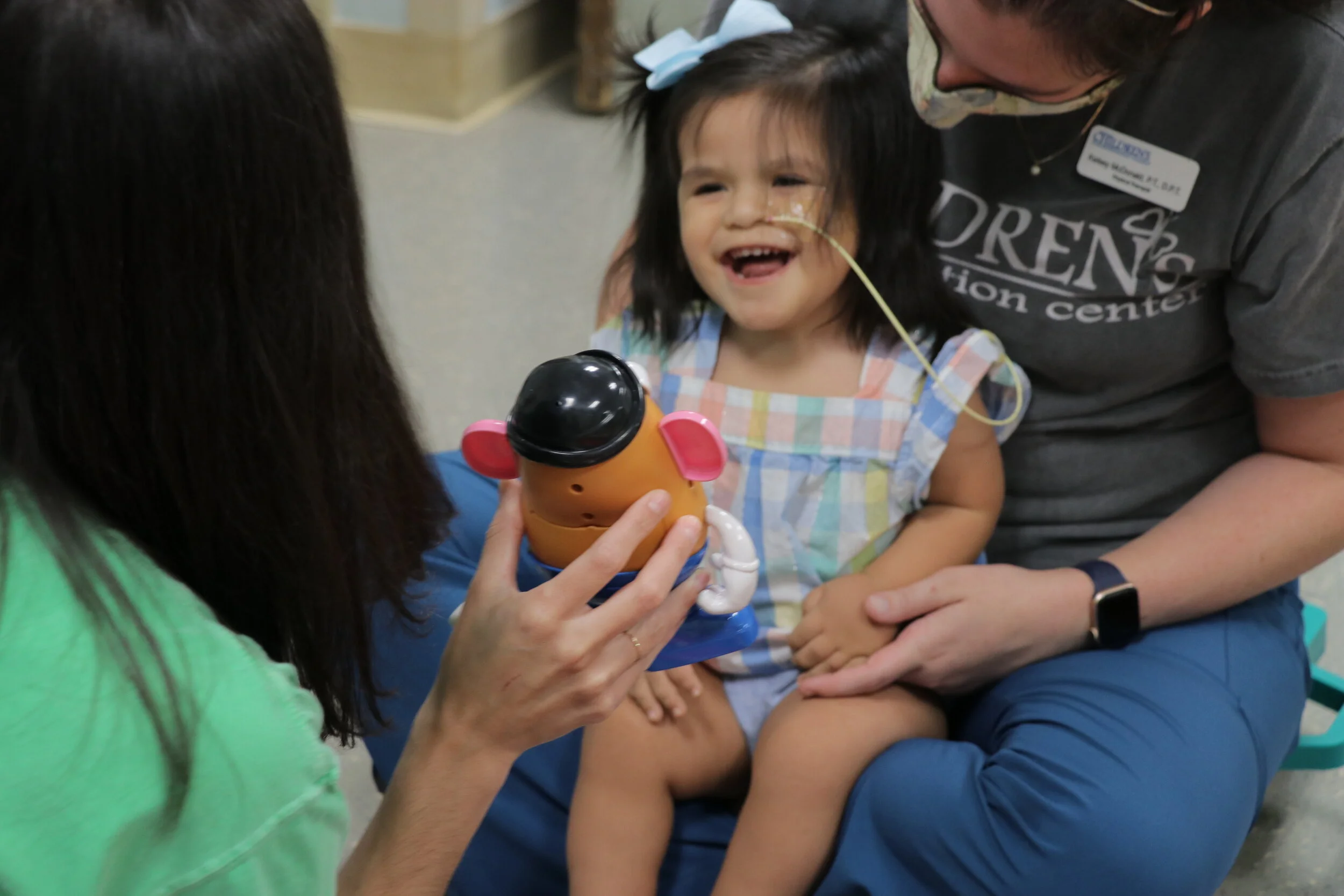
“Sienna is a bright spot in my day. Her infectious smile can change the mood of an entire room,” said Kelsey McDonald, PT, DPT.

“One of the best things about working at MCRC, is seeing the progress that children make over time”, said Kristal Kidd, M.P.T. Brittany Nelson is one of those kids. Having been a client at MCRC for over six years, her therapists have had the privilege of witnessing a tremendous amount of growth.
Before attending MCRC, Brittany faced huge obstacles with strength and coordination. Ordinary tasks like writing her name or taking a step off of a curb were extremely difficult. The now 19-year-old has been transforming in front of many eyes.
Through the introduction of occupational therapy, physical therapy, speech therapy, hippotherapy, and therapeutic riding, Brittany has gained new skills like dribbling a basketball for extended periods, the ability to jump off objects and use her fine motor skills to rein her horse independently.

“She rapidly progressed due to her parent’s diligence with home carry over.” - Jennifer Austin, M.S. C.C.C., S.L.P.

Tyler is a precious, happy four-year-old boy who loves to smile, socialize, give hugs and fist bumps. He is extremely interested in people and very sensitive to their emotions. Tyler is easily one of the most beloved children at the center. Many people, especially his therapists were sad to learn that his family is moving to Alaska soon because he was so close to reaching a milestone everyone had been working towards for two and a half years: his first steps.
Tyler is a four-year-old patient at MCRC and loves his therapists
Before he was born, his parents discovered that his brain had formed a little bit differently and knew that a realm of possibilities, issues and challenges awaited them. Tyler needed the help of several services that MCRC offers.

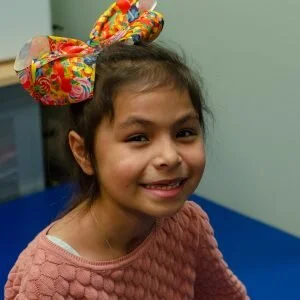
It’s been just a year since Brooklyn, a typical little girl, was diagnosed with acute flaccid myelitis (AFM). AFM causes polio-like conditions such as muscle weakness and paralysis and it attacked Brooklyn’s upper extremity and respiratory system. She had to undergo a tracheotomy because she couldn’t breathe on her own. Brooklyn suffered a devastating change to her body in such a short time and she wasn’t going to recover on her own.
When she first came to the center, Brooklyn ate through a g-tube, was on a ventilator 7 hours a day, and was prone to falling because of her extreme weakened state. She needed both physical and occupational therapy to enable her to overcome the effects of AFM. Over the past 10 months, with the help of physical therapy, therapeutic riding, and occupational therapy, she has made extraordinary progress.

Carter was 3 years old when he was diagnosed with a sensory processing disorder, anxiety disorder, and PDD-NOS, one of four developmental autism spectrum disorders. The family found it difficult to go out in public making a home-schooled education an easy choice for Carter. Early in his schooling, Carter was plugged into an MCRC writing boot-camp and, consequentially, referred to receive occupational physical and speech therapy at MCRC. He began to make some headway by learning how to live with some his life-long limitations.
However, not everything was lining up for the 9-year-old. Carter was still struggling with his homework assignments but due to his homeschooling and poor eyesight he had never been tested for a learning disorder. Homeschoolers don’t have as easy of a time accessing many of the resources available to students in public systems so the family had to figure out their next step. It wasn’t until a specialist at Scottish Rite told the Edwards that Carter had one of the worst cases of dyslexia that they had ever seen.

Grant just had his 5th birthday a few months ago and his imagination is jam packed with extraordinary ideas. On a regular basis he can be caught overcoming evil super villains alongside his superhero action figures. As he makes them struggle against each other in epic battles, you might be able to hear him narrating classic comic book dialogue between good and evil and think that he’s just another typical 5-year-old boy.
“Grant loves to watch movies, like really watch them, swims, plays outside and videogames. He basically does what all 5-year-old boys do,” Mom says. “That’s why it was so hard… not knowing whether he was hungry or needed to go potty was hard for us. He knew what he wanted and what we wanted from him, but it was super frustrating for Grant because he couldn’t tell us what he wanted.”

If you’ve been around the center long enough, then you’ve probably met Hannah. Ask anyone about Hannah and the first thing they’ll tell you is that she has a joyful personality, her attitude is contagious, and her smile lights up the room.
Hannah has been receiving occupational, physical, and speech therapy at MCRC for over 7 years. Throughout that time, her therapists have set plenty of objectives for her as she works towards developmental goals that include strengthening her core, improving her verbal communication and a deeper capability for self care. Mom even says, “she wants to do chores, too,” a comment Hannah could neither confirm nor deny through her laughter.
Hannah’s diagnosis of Hypoxic ischemic encephalopathy and Transfemoral amputation of her right leg requires her to use a wheelchair, traditional stander and a prosthesis. However, a few months ago Hannah outgrew her stander and it was no longer able to meet her needs. Having the ability to stand is something that many of us take for granted. The act of standing helps improve our respiration, voice control, and our posture, while increasing bone density and circulation – benefits Hannah was at risk of losing if something was not done.

When Harper was a baby, she was diagnosed with Craniosynostosis. Craniosynostosis is a birth defect that causes the joints between the bones of a baby’s skull to close prematurely before the brain is fully formed. Then last year Harper received a diagnosis of Tublin Gene Malformation. Doctors informed Harper’s parents she may never walk or talk and there was a possibility she would be in a vegetative state. Harper’s parents didn’t accept that and neither did Harper.
Harper first came to Midland Children’s Rehabilitation Center to start a feeding program through speech therapy. Jacie Durham, M.S. C.C.C.-SLP, helped Harper with food acceptance, chewing and tongue laterization. After successfully completing the feeding program, Harper began receiving therapy through all three disciplines.

Catherine’s life began on a feeding tube, oxygen and care flight to Cook Children’s to fight for her life against meningitis and a diagnosis of Prader-Willi. Prader-Willi syndrome is a genetic condition that affects many parts of the body. Catherine’s parents were told to expect substantial milestone delays and prepare for significant, lifelong cognitive deficits.
Catherine first came to Midland Children’s Rehabilitation Center (MCRC) to participate in Motor Mouths. Motor Mouths is a four-week program that focuses on feeding, speech and language development. Beginning of 2018, Catherine started physical therapy with Kristal Kidd M.P.T.. When she first started, she was unable to hold her head up while on her stomach, roll, sit up or crawl.

Presley has been coming to Midland Children’s Rehabilitation Center for 7 years, and has been part of our therapeutic riding group since 2014. You’ve probably seen her perform at our Rodeo Play Day in previous years, but this year Assistant Barn Manager Laura Buzbee wanted to praise how far Presley has come.
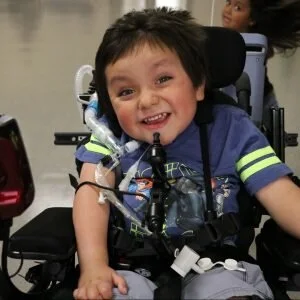
It had been over two years since Adrian, 4, was able to move on his own, that is until he got his new power chair. Adrian was a 2-year-old with excellent health and age appropriate in development, until he was in a terrible accident in 2015. Since the accident the only movement Adrian has is moving his head and shrugging his shoulders.
For the past 18 months Adrian’s physical therapist at MCRC, Elizabeth Chalambaga, D.P.T., and Adrian’s family have done everything possible to show Adrian’s health insurance he has the need for the chair, as well as his capability in safely driving and controlling the chair.
When Adrian received the chair a couple of weeks ago, the first thing he did was chase his sister around and play hide and seek with his mom, two normal activities any 4-year-old does.

When he began, he was completely nonverbal. He wouldn’t play with his peers or siblings, there was no engagement, and he seemed to be in his own little world.
But as of December 2016, Kai has emerged and is now quite verbal. He consistently uses 2-3 word phrases and can now effectively communicate his needs and wants. He follows several-step directions and now engages others in communication.